Agenda 2026
Check Out Our agenda
Find out more details as the speaker sessions are revealed for our 2026 agenda.
PLAN YOUR DAY, YOUR Way
Thursday, September 24th, 2026
Key:
Technical Talks =
Leadership Talks =
AI Scotland Session =

08:30 - 09:00
registration
Tea, coffee and breakfast rolls on arrival.
09:15 - 09:30
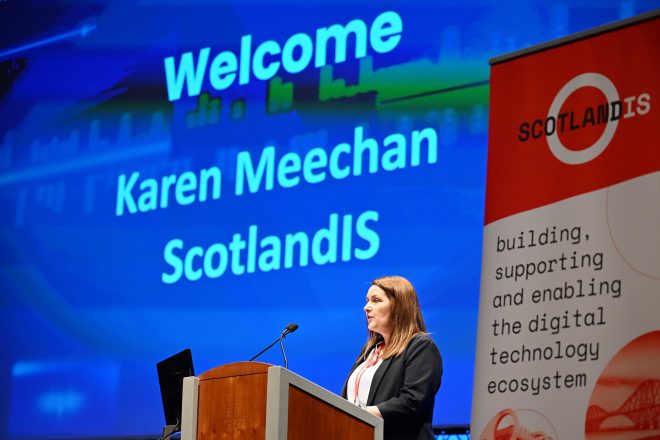
Welcome
CEO, ScotlandIS
09:30 - 09:55
Ministerial Welcome
09:55 - 10:55
Keynote - Trust Me, I’m an Algorithm: Building Trust in the Age of AI
Emma Logan, Deputy President, BCS
AI is shaping the systems that run our businesses, public services, and our everyday lives. As organisations move quickly to adopt AI, the question is no longer simply what the technology can do, but whether we can trust the people designing, building and deploying it to do so competently and responsibly.
In this keynote, Emma Logan - Deputy President of BCS, The Chartered Institute for IT - and former Equity Partner at KPMG UK explores why trust in AI ultimately depends on the professionalism of the people behind it. Powerful technology combined with weak governance and unclear accountability creates risks that technical capability alone cannot solve. Drawing on examples from industry, Emma will argue that trusted AI depends on skilled professionals who understand their responsibilities, work to clear ethical standards, and can be held accountable for the systems they create.
11:00 - 11:20
coffee break
Tea, coffee and biscuits will be provided, with the chance to network and browse the exhibition hall.
11:30 - 12:10
Legal Privilege in Managing Cyber Incidents
Nick Warrillow, Partner, Disputes & Regulatory, and Rebecca Roberts, Director, Disputes & Regulatory, at Burness Paull
Nick and Rebecca from the Disputes & Regulatory team at Burness Paull will discuss understanding around legal privilege involved in managing a cyber incident.
They'll cover in more detail how privilege is relevant to cyber incident, an overview of different forms of privilege, how to preserve privilege and how not to waive it, concluding with a summary of the key Do's and Don'ts.
This information is imperative for founders and senior leaders looking to inform themselves of the legal implications surrounding a cyber attack.
11:30 - 12:10
AI, Hack that for me
William Wright, CEO, Closed Door Security, and Cian Heasley, Principal Consultant and CTI Lead, Acumen Cyber
AI-orchestrated attacks are already happening at scale. This is a technical walkthrough of how they work, automating an attack chain with no human input, what worked, what broke, and why.
11:30 - 12:10
The Next Evolution of Demand Generation: Why Understanding Buyers Matters More Than Finding Them
Brian Williamson, CEO, Synlata
Technology companies have never had more access to data, intent signals, automation tools and AI-driven outreach. Yet many continue to face the same challenge: finding predictable, scalable growth.
For years, the industry has focused on identifying who to engage. Intent platforms help us understand which organisations are researching solutions. Revenue intelligence platforms help us analyse what happened after engagement took place.
However, a gap remains. Many organisations still struggle to understand how buyers make decisions, what drives engagement, and why similar prospects can respond very differently to the same message. The traditional answer has been to hire exceptional salespeople, but truly great salespeople are rare, difficult to scale and often succeed because of instincts and behaviours that are hard to replicate. What if the answer is not finding more exceptional salespeople, but understanding the characteristics, insights and approaches that make them successful and applying them consistently across an entire organisation?
This session explores the emergence of a new intelligence layer that combines business intelligence, behavioural insight, market signals and human interaction to create a deeper understanding of buyers and buying behaviour. Drawing on insights derived from more than 3.4 million real-world B2B technology conversations, alongside practical examples from across the technology sector, the session will examine how technology companies can improve sales effectiveness, increase relevance and reduce buyer resistance by moving beyond activity and intent towards genuine understanding. Attendees will leave with practical insights into how data, behavioural analysis and human expertise can be combined to create better conversations, stronger engagement and improved commercial outcomes.
11:30 - 12:10
Accelerate Lead Engagement with an AI-Powered Inbound Lead Agent
Rita Patley, Senior Microsoft 365 Consultant, and Suzanne Burton, Principal Dynamics CE Consultant, at Telefónica Tech UK&I
See an AI-powered inbound lead agent in action, from the moment a new enquiry is received through to qualification and sales handover. Discover how AI and automation can enable faster lead engagement, gather key information and identify the most promising opportunities, while allowing sales teams to focus on higher-value conversations and human expertise where it matters most.
11:30 - 12:10
Computing with Light: When Your AI Lives in Physics
Dr Giulia Marcucci, Co-Founder & CEO, LumiAIres Ltd
AI is hitting four hard walls — energy, memory, latency, cost — and they share one root cause: digital silicon computes every weight and activation, link by link, paying the bill whether the result matters or not. LumiAIres' photonic neuromorphic chips do something different. The neural network is not loaded onto the chip; it emerges from the nonlinear interference of light inside a photonic reservoir, and only the readout layer is trained.
This talk is a software stack tour of what changes when your AI lives in physics: how training pipelines simplify, how inference moves from cloud to edge, and why hardware–software co-design takes the four walls out of the equation.
11:30 - 12:10
AI Research & Development in Scotland: From World-Class Research to Real-World Impact (panel)
Ana Rojo-Echeburúa, Fractional CTO, AinTools; Professor David Lowe, Clinical Director of Innovation, University of Glasgow; Lucy Fraser, Founder, Sunnd Technologies
Scotland is internationally recognised for its strength in artificial intelligence research, with leading universities driving breakthroughs in robotics, machine learning, trustworthy AI, natural language processing, healthcare, manufacturing and data science. The challenge now is ensuring that this research translates into innovation, commercialisation and improved public services.
This panel brings together leading researchers from across Scotland to explore where the next wave of AI innovation is emerging, how universities are collaborating with industry and government, and how AI R&D can help deliver economic growth, public sector transformation and global competitiveness.
12:20 - 13:00
Debugging the Org Chart: Influence and Hierarchy in a Hybrid World
Tim Clarke, Business and Improvement Analyst, Katoni Engineering
Most complex technology transformations don't fail because the strategy or technology was wrong. They fail because they were planned using a comfortable fallacy: the org chart. When organisations prepare for change, they map their processes. Rarely, if ever, do they map their people. Yet the informal networks of trust, influence, and communication within every organisation are precisely what determine whether change takes hold or quietly dies.
Organisational Network Analysis (ONA) makes those invisible structures visible. Using passive signals, calendar data; email metadata; project collaboration, alongside active surveying, ONA produces a data-driven picture of how work actually happens. Underpinned by graph databases, centrality algorithms, and community detection, ONA identifies informal influencers whose buy-in matters more than any leadership mandate, knowledge brokers who translate new ideas into practice, and bottlenecks where resistance will crystallise.
This argument becomes urgent when change involves integrating AI Agents into everyday workflows. Deploying autonomous systems without understanding an organisation's social topology won't aid transformation; it will exacerbate existing dysfunction.
This session covers passive versus active data collection, graph analytical techniques, and the practitioner tooling landscape. Attendees leave with a concrete framework for applying ONA to their own transformation challenges.
12:20 - 13:00
The Leapfrog Problem: Why the Best-Prepared Get Left Behind
Mark Rodger, Head of Finance and Business Central, Telefónica Tech UK&I
Every major shift - steam, the internet, cloud - rewards the same trait and punishes its opposite. Britain built one of the world's earliest telephone networks and is still paying for the copper. Other countries arrived late, with nothing to protect, and leapfrogged straight to world-class infrastructure. The lesson isn't "adopt late" - it's that the heaviest burden in any shift is your own investment in the way things used to work.
AI is the next such shift, and it lands hardest on the public sector, where decades of legacy systems and hard-won processes are both an asset and an anchor. Drawing on our experience delivering AI-enabled solutions on Dynamics 365 and the Power Platform - including close collaboration with Microsoft's teams - this session explores how AI changes not just how we build, but the questions we ask before we build at all. We'll look at why yesterday's winners are often slowest to adapt, why "move fast and deregulate" is the wrong lesson, and what a deliberate, managed leapfrog looks like when public value can't be an afterthought.
12:20 - 13:00
Beyond Compliance: Real Leadership in Cyber Risk and Governance (panel)
Calum Michie, Principal Cyber & Technology Risk Consultant, i-confidential (panel chair); Maggie Titmuss MBE, Non Executive Director & Board Advisor; Nicolas Mautner, CISO and Head of Risk, CyberHelm; Paula Kershaw, MD - Cyber, Resilience and Risk
Attendees will hear a practical discussion on what it really means to lead cyber risk beyond regulatory compliance and assurance checklists. The panel will explore how boards, cyber leaders and practitioners can move from compliance evidence-gathering to genuine risk ownership, better decision-making and stronger organisational resilience. The panel will explore what good governance looks like under pressure, how cyber risk can be translated into business impact, where accountability should sit, and how leaders can make informed trade-offs across security, operations, innovation, suppliers and regulation.
12:20 - 13:00
From digital projects to digital revenue: why IT Is marketing’s most important growth partner
Mike Buick, Director - Digital Revenue, Helix Revenue
Many businesses invest in websites, CRM, analytics, automation and AI, but still struggle to connect digital activity to measurable growth. The issue is rarely technology alone. More often, platforms, data, customer journeys and commercial goals are not joined up clearly enough.
This practical session explores how IT and technical teams can play a bigger role in turning marketing ambition into revenue outcomes. Drawing on lessons from ecommerce, healthcare and digital transformation, it will show how growing technology businesses can make digital projects easier to measure, easier to act on and more valuable commercially.
You will leave with specific actions and tools that can be implemented straight away to link marketing technology decisions to customer behaviour, and business growth.
12:20 - 13:00
Defending Against Adversarial AI
Kostandino Kustas, Senior Cybersecurity Consultant, N-able Technologies
AI promises speed, scale, and efficiency for organisations across business and operational functions. This new dawn of efficiency is extremely prominent in the InfoSec space, where AI is taking on a truly invaluable defensive capability. However, as is evidenced in the threat landscape of 2026, AI is no longer just a driver of efficiency and defensive capability, but instead AI is mapping out an ever-growing attack surface.
From AI‑generated social engineering to full-scale automated attacker tradecraft, adversarial AI is truly reshaping the threat landscape, posing real risk to the organisation and business resilience strategies of yester-year.
Join us as we focus on how the double-edged nature of AI in cybersecurity – how threat actors are weaponising AI, and how modern defence must evolve! Leaving the AI hype at the door, we’ll discuss the principles of what good AI‑assisted security looks like, cover the ever more important human-in-the-loop judgement factor.
12:20 - 13:00
Skills, Agents, and the New Shape of Work: Designing for AI That Works Alongside You
Dr Marcel Lukas, Senior Lecturer in Banking and Finance, and Vice-Dean of Executive Education, University of St Andrews Business School
Something has shifted in how software gets built. The interesting unit is no longer the prompt or even the model, but the skill: a small, composable instruction set that lets an AI agent do real work inside a real workflow.
In this 40 minute session, Marcel shares what he has learned building and deploying skills in his own practice, from executive education to research, and what it means for how software teams should think about product design, tooling, and team structure in 2026.
Expect concrete examples, a live look at a working skill, and a frank take on where agents genuinely help, where they create new failure modes, and what the next twelve months are likely to bring. You will leave with a clearer mental model of skills and agents, and a short list of questions to take back to your own roadmap.
13:00 - 13:50
Lunch
14:00 - 14:40
Smart Workflows or Agents? Choosing Predictability Over Hype
Matt Leeper, CEO, Silmaril Consulting Ltd
Autonomous AI agents are dominating industry hype, but are they actually the right tool for production environments? This talk cuts through the marketing noise to translate complex agentic architectures into clear, bottom line realities for engineering teams and management alike.
While frameworks like LangGraph and Anthropic Agents offer impressive autonomy, they often introduce non-deterministic loops, potentially soaring token costs, and intense debugging challenges. We will argue that for most enterprise needs, the superior choice is structured automation workflows embedded with isolated LLM layers at critical decision points.
Using real world client case studies, we will compare autonomous agent execution against structured, deterministic workflows. Attendees will learn how to build architectures that prioritise auditable outputs, strict cost control, and system predictability, proving that simpler engineering often yields superior, production ready results.
14:00 - 14:40
Fireside Chat - digitalisation journey across the energy industry
Laure Mora, Business Growth & Transformation Manager, Offshore Energies UK (OEUK), & Stephanie Calder, CEO, Asset Guardian Solutions
Laure is an energy industry professional, with more than 20 years experience. Her career started as an engineer in the Oil and Gas industry, in mainly operations engineering and commercial roles. She expanded her career to waste heat recovery and geothermal in 2019 and subsequently worked in green hydrogen. Using her cross-energy knowledge, she led an energy start-up programme at the Net Zero Technology Centre before joining Offshore Energies UK in 2024 as Business Growth & Transformation Manager. In this role, she heads the various OEUK data and digital groups and organises the yearly OEUK Data and Digital Conference. She is passionate about the proper implementation and use of digital tools across the whole energy industry to improve project delivery.
14:00 - 14:40
Can We Trust Data Anymore? How Blockchain Restores Trust
Rajesh Kumar Plamthottathil, Founder & CEO, TrackGenesis
In a world of AI-generated content, deepfakes, and growing concerns about misinformation, it’s becoming harder to know what data we can rely on. This talk explores how blockchain can help bring trust back into digital systems in a simple and practical way.
Rather than focusing on complex technical details, we will look at real-world examples show how blockchain is already being used today. The session will explain key ideas in plain language and highlight when blockchain is genuinely useful, and when it isn’t.
By the end, you will have a clear understanding of how blockchain can help solve real problems around trust, and where it fits in an increasingly digital world.
14:00 - 14:40
AI in healthcare: From scottish innovation to global impact (panel)
Dr Elizabeth Fairley, Co-Founder of Talking Medicines; Abhilesh Ghandi, CTO, Craneware; Ishani Malhotra, CEO and Co-Founder, Oncocine
Scotland has a strong and growing health technology sector, with expertise spanning artificial intelligence, diagnostics, remote monitoring, medical imaging, health data and personalised care. The opportunity is significant, but taking an AI-enabled healthcare solution from initial development to clinical adoption - and then into international markets - remains challenging.
This panel will bring together Scottish health technology businesses, healthcare leaders and international market specialists to explore how Scotland can turn its strengths in AI and health innovation into successful, scalable global businesses.
The discussion will consider how companies move from research and pilots into routine clinical use, building the evidence, trust and assurance needed for healthcare AI, using NHS collaboration and validation to support international credibility, navigating regulation, procurement and reimbursement in different markets, choosing the right international markets and partners, accessing investment and support for overseas growth, and ensuring international success creates jobs, skills and economic value in Scotland. The panel will share practical experiences of what has worked, what has slowed progress and what more Scotland could do to help its health technology companies scale internationally.
14:00 - 14:40
Building AI Readiness and Commercialising AI: From Readiness to Revenue
Keith O'Donnell, Managing Director, Feynic Technology; Alex Clyne, Co-Founder, Jump Digital Ltd
Do you understand your own and your organisation's AI readiness? Do you know how to protect your knowledge and intellectual property? Or are you ready to commercialise an AI product or service? If so, this workshop is for you.
Join Alex and Keith for an interactive session exploring the journey from AI readiness to commercialisation. Together, you'll assess where your organisation AI Readiness is today, discuss common challenges with fellow participants, and identify practical next steps to accelerate your AI strategy.
You'll also discover how to unlock, develop and scale your intellectual property, from the earliest stages of innovation through to successful global commercialisation.
Complimentary Benefit: Every attendee will receive free access to AiR (AI Readiness), including a personalised AI readiness assessment, Smart Index score, and tailored action plan, normally valued at £500.
14:00 - 14:40
Behind The Veil - A Glimpse into the Murky World of Cybercrime
Jon Hope, Senior Technology Evangelist, Sophos
The headlines are full of stories of cyber attacks, but have you ever wondered who are behind these attacks?
Who are the cybercriminals, where do they come from and what tactics do they employ?
More importantly still what can we learn from the history of ransomware so that we can be better prepared and more resilient in the future?
14:50 - 15:30
Your Software Isn't Dead. Your UI Is.
Nick Finch, Chief Technology Officer, inmydata
Software companies have spent decades building complex UIs on top of valuable business logic and data. Agentic AI is collapsing that model right now. When an AI agent can talk directly to your system's API, your carefully crafted interface becomes optional. That's not a threat. It's an opportunity.
The companies that thrive in this shift won't be the ones racing to bolt AI features onto their existing products. They'll be the ones that recognise what they actually have, deep domain logic, proprietary data, years of encoded expertise, and package it for a world where agents are the new interface.
This talk draws on real systems built in production over the past four years. An expert buying system that synthesises ERP data, commodity markets, weather patterns and crop forecasts to help coffee buyers make better decisions. An intelligent knowledge capture platform that interviews subject matter experts and turns tacit expertise into queryable intelligence. Both built by a four-person team using AI-first engineering practices.
You'll leave with a clear framework for identifying what's valuable in your own software, what's about to become irrelevant, and what to do about it.
14:50 - 15:30
The Future of AI Infrastructure: Compute, Connectivity and Clean Energy (panel)
Ritchie Somerville, Deputy Director, EPCC; Michael Hunter, Director of Data Centre Partnerships, Apatura; Colin Lindsay, Developer & Hydrogen Services Manager, Scottish Water Horizons; Richard Woodfield, Head of Solution Services, DataVita
Artificial intelligence is transforming industries, but behind every AI model sits an enormous amount of infrastructure—from data centres and cloud computing to energy networks, fibre connectivity and high-performance compute.
Scotland has many of the ingredients needed to become a leader in sustainable AI infrastructure, including abundant renewable energy, world-class universities, a growing technology sector and ambitious net zero targets. However, attracting investment while balancing environmental considerations, grid capacity and community impact remains a significant challenge.
This panel will explore how Scotland can develop the infrastructure needed to support AI innovation sustainably, what opportunities exist for economic growth, and how government, industry and academia can work together to position Scotland as a destination for responsible AI investment.
14:50 - 15:30
Cyber Recovery Wargame
Chris Butler, Business Resilience Director, Databarracks
In this highly interactive Cyber Recovery Wargame, attendees will take on the role of senior leaders managing a live ransomware attack complicated by deepfake content and AI-driven disinformation.
With disinformation and misinformation topping the 2025 World Economic Forum Global Risk Report, this scenario brings the threat to your doorstep. Can your leadership withstand the pressure?
Using live Slido polling, both in-person and virtual attendees will shape the outcome. This session offers a powerful, hands-on experience in cyber crisis leadership and practical insights to improve organisational resilience against the rising threat of AI-driven misinformation and cyber threats.
14:50 - 15:30
Could You Defend That Decision? Cyber, Data and Trust in Practice
Irene Coyle, Chief Operating Officer and Data Protection Officer, OSP Cyber Academy
Every day, leaders and employees make decisions involving data, technology and AI, often without fully understanding the cyber, privacy and organisational risks involved
In this highly interactive workshop, Irene will have delegates work through simple real-world scenarios, test their decision-making and explore how seemingly small choices can quickly escalate into significant cyber, data protection and reputational incidents. Through live discussion, practical exercises and audience participation, attendees will discover how to ask the right questions, challenge assumptions and make better risk-based decisions in an increasingly complex digital world. Delegates will leave with a practical framework that can be immediately applied within your own organisation to strengthen trust, resilience and accountability.
14:50 - 15:30
From Silicon to Superconductors: Manufacturing and Integration for Scalable Quantum Systems
Martin Weides, Director of James Watt Nanofabrication Centre (JWNC), University of Glasgow
Quantum technologies are now moving beyond laboratory demonstrations toward scalable, manufacturable systems. This talk focuses on the critical role of advanced nanofabrication and system integration in enabling that transition.
Drawing on developments at the James Watt Nanofabrication Centre (JWNC) and the emerging ecosystem around Quantcore and Kelvin Quantum, the session will explore how superconducting circuits, semiconductor platforms, and photonic systems are being engineered—and crucially, interfaced—to build practical quantum hardware. Key challenges such as fabrication yield, materials control, and reproducibility will be discussed, alongside approaches to hybrid integration, chiplet architectures, and high-density interconnects.
The talk will further highlight how initiatives such the Scotland Critical Technologies Supercluster and the Critical Technologies Accelerator are strengthening the link between design, fabrication, and packaging, enabling more reliable and scalable quantum devices.
14:50 - 15:30
Breaking Borders: Navigating EU AI and Data Rules for Tech Growth
Lisa-Marie Schuchardt, Attorney-at-law, NEON
Expanding into the EU market offers significant opportunities for tech companies, but also comes with complex regulatory challenges.
This talk provides a practical overview of key EU frameworks such as the AI Act, General Data Protection Regulation and the EU Data Act, focusing on what they mean for AI-driven products and data use in practice. It highlights common pitfalls, compliance strategies, and how to integrate legal considerations early in product development to support scalable and sustainable growth.
In addition, it draws on lessons from venture capital financing rounds and exits, showing how regulatory readiness can impact valuations, due diligence processes, and successful scaling or exit strategies.
15:35 - 15:55
coffee break
Tea, coffee and biscuits will be provided, with the chance to network and browse the exhibition hall.
16:00 - 17:00
keynote - The future of our sector (panel)
Nicola Taylor, COO, ScotlandIS (chair); James Varga, Co-Founder, somai studio; Abhilesh Ghandi, CTO, Craneware; Natasha Nicholson, CEO, Space Scotland; Laure Mora, Business Growth & Transformation Manager, Offshore Energies UK (OEUK)
Scotland’s technology sector is in a period of profound change. Artificial intelligence, advanced data capabilities and emerging technologies are reshaping not only the tech industry itself, but also the way businesses operate, public services are delivered and Scotland’s wider economy competes internationally.
This panel will explore what the future of Scotland’s tech sector looks like in an increasingly AI-driven economy, with a particular focus on the relationships between technology and other sectors — from healthcare, to manufacturing to energy and the public sector. The discussion will consider how these relationships can create new markets and accelerate innovation.
17:00 - 17:15
conference close
CEO, ScotlandIS
Young Software Engineer awards dinner
18:15 - 18:45
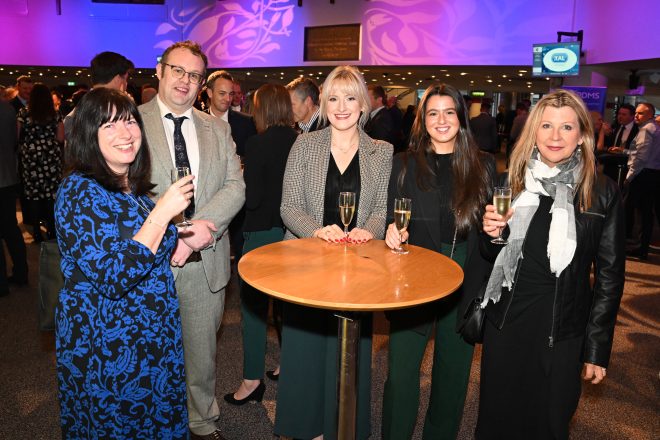
champagne reception
We’ll kick off the evening with our champagne reception and networking.
18:45 - 21:25
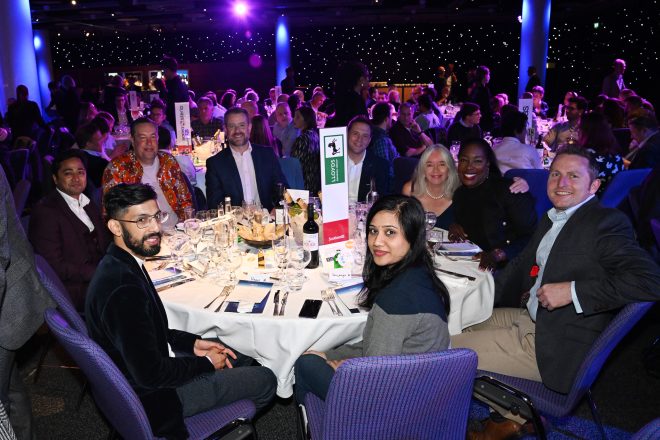
Dinner
Welcome and housekeeping, before three-course dinner and wine.
21:25 - 22:00
young software engineer of the year awards
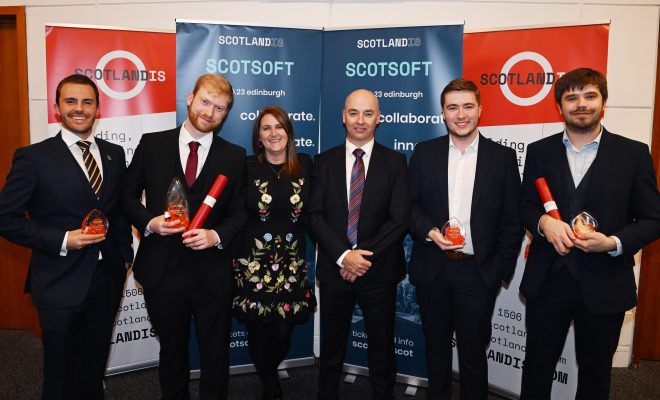
For over 30 years, we’ve been celebrating the young software engineers of tomorrow from each of our Scottish universities; many have gone on to perform some incredible roles and achievements around the globe. We will award the 1st place, 2nd place, 3rd place, and Best Engineering Prize to students on the night, with prizes kindly sponsored by Sopra Steria, BCS, Resillion and Leidos respectively.
22:15 - 23:00
after dinner entertainment
A brief welcome from After Dinner Entertainment sponsor, Lloyds Banking Group, will be followed by a set from our musical act.
23:00
official event close
23:55
coach to glasgow leaves
01.00
bar closes
Last Year Was Amazing.
take a look.