
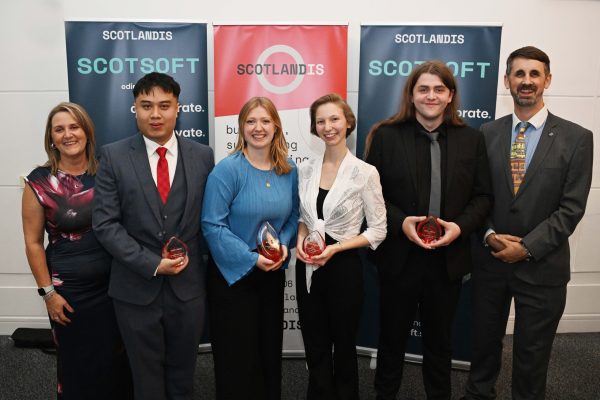
- St Andrews University computer science student, Verity Powell, has been named Young Software Engineer of the Year.
- The first prize, sponsored by Sopra Steria, was awarded to a project that aimed to bridge the gap between professional rugby players and community players by using computer vision techniques to make video feedback technology accessible for players at a community level.
- Klara Krämer, University of Aberdeen and Zin Lin Htun, Edinburgh Napier University, were named in second and third place respectively. University of Dundee’s Naomi Silver picked up the Best Engineering Prize.
A student from St Andrews University has been officially named this year’s Young Software Engineer of the Year. Organised by ScotlandIS, the membership and cluster management organisation for Scotland’s digital technologies industry, the awards recognise the best and brightest computing science students that Scottish universities have to offer.
Verity Powell’s winning entry, Video Analytics for Rugby Skills Training, aimed to bridge the gap between professional rugby and the grassroots community game. By using computer vision techniques to automatically analyse conversion kicking attempts, it provides feedback based on their movement and coaching research. It stood out to the judges as a highly innovative approach that brought a niche, complex, expensive product to a broader, less affluent market.
The 36th annual Young Software Engineer of the Year awards took place in Edinburgh last night (25 September) at ScotlandIS’ annual flagship conference, ScotSoft. All four of the winners received a trophy, along with a cash prize in recognition of their achievements.
Judging was conducted by a panel of industry experts who were collectively impressed by the level of skill and broad range of challenges addressed by this year’s entries. The criteria used included degree of innovation, technical difficulty, level of knowledge and previous research as well as commercial and social relevance. Quality of engineering, planning, organisation and standard of presentation were also considered.
Although there can be only one winner, both runners up and the winner of the best engineering prize received the highest praise from the judges. Impressed by the calibre of this year’s competition, the panel felt many of the entries showed novel solutions in the integration and reuse of existing components; an area of expertise which is of growing importance in industry.
Second prize, sponsored by BCS, was won by Aberdeen University’s Klara Krämer which aimed to address the quality of input data by combining it with human intuition. Third prize, sponsored by Resillion, was won by Zin Lin Htun from Edinburgh Napier University who aimed to construct a multimodal robot that can walk, drive and carry out hybrid operations. Finally, Naomi Silver picked up the Engineering Prize, sponsored by Leidos, for her Novostok, a handheld console for retro game preservation.
Karen Meechan, CEO at ScotlandIS said: “Every year, the calibre of entries becomes more impressive. This year, we were particularly struck by the level of skill involved in the entries which was far beyond what you might expect of a graduate level developer. How closely the entries aligned to the priority needs of today’s tech sector was also impressive, showing a strong understanding of what challenges may lie ahead. Our members often talk about the importance of ensuring education equips graduates with the skills businesses actually need, so it’s encouraging to see such promise coming through in our graduates.
“Congratulations to all of the winners, and to those who made the shortlist – it’s an incredible achievement and one you’ll carry for the rest of your career. Of course, a special thanks to our sponsors for their generous ongoing support.”
Speaking shortly after receiving her award, Verity explained why she had chosen this area as a focus for her research.
She said: “Having played for the University’s Women’s 1XV (first 15) Rugby team, I’ve experienced first-hand how limited funding can hold women’s sport back, preventing them from accessing the most innovative techniques and tools. At the same time, I’ve always been inspired by the power of technology and how it can be used to open new doors. Being able to combine my passions for sport and technology to create more accessible resources for community players is a real privilege. I hope my research will be used as a stepping stone towards a greater degree of equality in both education and women’s sport.”
The full list of shortlisted students was:
- Klara Krämer, University of Aberdeen
- Denis Dimitrov, Abertay University
- Naomi Silver, University of Dundee
- Guy Torbet, University of Edinburgh
- Zin Lin Htun, Edinburgh Napier University
- Christopher Eccles, University of Glasgow
- Joanna Hoppe, Glasgow Caledonian University
- Joe Gilligan, Heriot Watt University
- Reece Mackie, Robert Gordon University
- Verity Powell, University of St Andrews
- Suniyah Ansari, University of Stirling
- Callum Sergeant, University of Strathclyde
- James Deas, University of the West of Scotland